 |
©
Sergey Petrov |
|
The way to the heart Dmitry Danilov
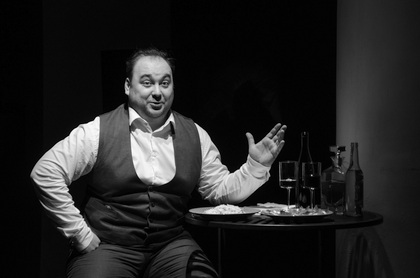
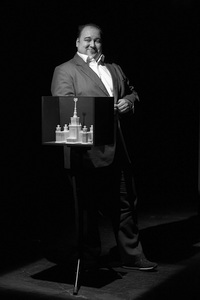
The Way to the Heart is a love story. Over the course of an hour, the protagonist, played by Igor Voynarovsky, tells the audience about the woman he loves and their complicated relationship, generously seasoning his monologue with recipes from Italian cuisine. His story races through the defining chapters of his life — sometimes flowing to the rhythm of a lyrical song, sometimes stumbling into syncopation: Moscow State University in the 1980s, the wild world of business in the 1990s, and the new realities of the 2000s. Deliberately stripping away illustrative detail, the creators have removed everything mundane and specific. The preparation of Italian dishes becomes merely a verbal backdrop to what truly matters: reflections on life, love, and the search for one's own path — the way to the heart. - An extraordinarily beautiful play. The author himself called it a “libretto,” envisaging it as an opera. Its first production, in April 2018, was a mono-opera at the Krasnoyarsk Philharmonic. Yet I believe the dramatic production is far more powerful, profound and truthful. Much of the credit undoubtedly belongs to Igor Voynarovsky, who gives a talented performance in this one-man show. It also contains a wealth of fascinating directorial and scenic ideas. What a pleasure it is when you come away from a performance with more than you could gain from simply reading the text!
- Andrey Dvoretskov, E-Vesti
- The secret of these productions’ success lies in the young director’s ability to capture not only contemporary realities but also the poetic rhythm of Danilov’s writing. The Way to the Heart was originally written as an opera libretto and has even been performed as such. Whenever the protagonist becomes agitated, he begins repeating the same phrase several times, like a broken record, and these repetitions and variations become a distinctive musical structure within the play.
- Marina Shimadina, Teatral
- A remarkably fine production, which I wholeheartedly recommend. I would particularly emphasize three things. First, director Alexey Kuzmin-Tarasov has remained entirely faithful to both the letter and the spirit of the play. Second, his interpretation of the protagonist coincides with my own on every essential point. That is not a necessity, of course, but it is gratifying for me as a spectator. And third, Igor’s performance gives the character of a man in love an additional depth: the protagonist is happy, we rejoice for him, he is filled with love, and that is what makes his account of the woman he loves so beautiful.
- Andrey Dvoretskov, E-Vesti
- Igor Voynarovsky even has the bearing of an opera soloist, and occasionally begins singing his favorite Italian arias. He recounts his achievements with a certain self-importance, but his confident, expansive gestures increasingly betray the confusion and helplessness of a man accustomed to controlling his life who has suddenly lost that control. And it is perhaps this loss of control that frightens him even more than the loss of the woman he loves.
- Marina Shimadina, Teatral
- It resembles an intimate, heart-to-heart conversation in a train compartment late at night. Igor Voynarovsky immediately wins the audience over, and before you know it, you are sympathizing with him as though he were one of your own: “Good grief, what that man has been through with this woman!” Yet there is still a certain note of madness running through it all.
- Marina Shimadina, Teatral
Opening night: December 11, 2019 Running time: 1 hour without intermission |