|
|
|
|
| | | 
|  |
| |
| |
| |
| |
| |
| |
| |
| |
| |
| |
| |
| |
| |
| |
| |
| |
| |
| |
| |
| |
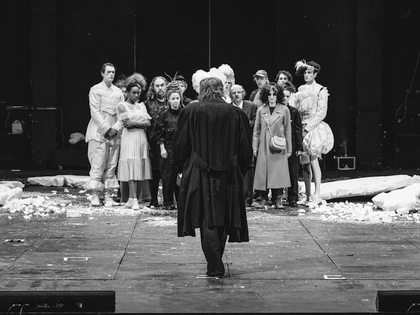
| | Mozart “Don Juan”. Dress rehearsal.
| |
| |
| |
| |
| |
| |
| |
| |
| |
| |
| |
| |
| |
| |
| |
| |
| |
| |
| |
| |
| |
| |
| |
| |
| |
| |
| |
| |
| |
| |
| |
| |
| |
| |
| |
|
|
|
|
|
|
|
|
|
|
|
|
|
| |

| 
| 
| 
| 
|
|
 |
©
Larisa Gerasimchuk |
|
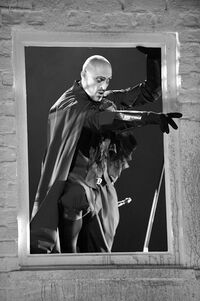
Mozart “Don Juan”. Dress rehearsal. - The theatrical And the Ship Sails On moves forward, shuddering and falling apart under the force of politically incorrect laughter at the entire culture of the past. Unless we destroy it, we cannot move on — and in this respect Krymov’s production echoes Bogomolov’s recent Carmen at the Perm Opera. But while Bogomolov releases the story of Carmen into contemporary life, Krymov, for the time being, speaks only about theatre. And by the end of Act One, the theatre of his Don Giovanni has literally run into a wall.
Here is the theatrical sleight of hand: a production about a despotic Director creating his world single-handedly has in fact been conceived by Krymov together with designer Maria Tregubova. The enormous moulded ceiling hanging crookedly over the stage in the second act, and an entire garden of objects materialised from the Director’s memories of his youth, create a space in which cranberry juice increasingly resembles blood and the Director’s wild fantasies somehow become reality. And he himself increasingly turns into Krymov’s alter ego. - Alla Shenderova, Kommersant
- The text of the production could be taken apart for quotations. Krymov, usually so restrained, allows himself here a dramaturgy bordering on graphomania. “It is at the meeting point of the divine and the base that theatre — and life itself — is born!” the Director declares in his self-aggrandising monologue. One can laugh like this only at oneself. And only among one’s own. That is why even Krymov’s black humour never turns into venomous satire. He does not expose his characters; he pities and caresses them, lovingly collecting theatrical clichés into an anthology of his own life. It is as though, for the first time, a Krymov production speaks with such power and freedom, with such painful and openly personal candour.
In this Fomenko Workshop premiere, it is also as though he allows his production, for the first time, the luxury of theatrical beauty. In Maria Tregubova’s design, theatre is both terrifying and beautiful. An enormous white frame covered in ornate mouldings looms over the actors, emphasising the incongruity of these poor, wretched people of the theatre. How can such people possibly inhabit such unearthly beauty? - Mila Deneva, Teatr.
- All of this is perfectly understandable. What is impossible to understand is how it has been achieved, from what reserves of feeling and what particular state of mind within the company it has been drawn. I cannot understand how the actors manage to sing like this — if it is a trick, it is one unknown to me. The music sounds so natural and effortless that it might be performed by professional singers, and yet at the same time it seems that everyone is singing for themselves, without any technical artifice. But the greatest miracle, of course, is Evgeny Tsyganov: encased in an enormous, elaborate costume and deprived of facial expression, he becomes the Über-marionette Craig dreamed of — an actor who has renounced accidental displays of emotion, obedient to the conception, embodying a complete and meticulously conceived image rather than a lifelike imitation. And yet beneath the symbolic mask he preserves the charisma of his own vivid personality.
Pyotr Fomenko once dreamed of whom and how Tsyganov would play in his productions: “Pyotr loved Zhenya very much; all his notebooks were covered with notes: leading role — Tsyganov, Tsyganov, Tsyganov. But almost everywhere Zhenya was eventually replaced by other actors because he was constantly asking to leave for filming,” recalls Maya Tupikova-Fomenko. Now Tsyganov has played the very essence of the Director’s profession. I think Fomenko would have been delighted to see it. - Alena Solntseva, Petersburg Theatre Journal
- Krymov has reminded us once again that theatre is not only a magnificent deception but also a magnificent pleasure. I cannot remember the last time I laughed so much or applauded with such enthusiasm the joyous absurdity unfolding on stage, constructed with absolute directorial freedom, fearlessness and impeccable mastery.
And then, of course, there is Evgeny Tsyganov as the director Evgeny Eduardovich. […] Before our eyes, Tsyganov restores the lost connection between actor and mask, character and performer. In its own way, it is an utterly mesmerising spectacle, recalling the great masters of commedia dell’arte. - Sergey Nikolaevich, Snob
- The impression made by Dmitry Krymov’s premiere at the Fomenko Workshop is so extraordinary that it puts an end, once and for all, to any notion that this artist might someday grow tired or exhaust himself.
There is nothing of the sort in Krymov. Instead, one feels that there is no measure to his talent, that it continues to fill from within, that all this is merely the beginning and that new triumphs still lie ahead. One also feels that his imagination demands ever more monumental embodiments; that his fairytale world of children’s toys and theatrical wigs is becoming ever more intimate and alive; and that the stage itself is no longer large enough to contain his extraordinary theatricality, magic and enchantment. Mozart. Don Giovanni. Dress Rehearsal is an immense artistic experience, a sense of the sheer magnitude of its conception, a production of tremendous scale and Krymov’s magnificent Amarcord to theatre, actors and everyone who makes a production possible. - Natalia Rtishcheva, Mnenie
- And when at last Mozart’s starched and powdered world, drunken Igor from the stage machinery department, Don Ottavio on crutches and Mother in Pitsunda, the murdered Don Giovanni and cafeteria worker Rosa with her khinkali, the greatest music of all time and pensioner Sashka with his high cholesterol, Seville and Moscow, the earthly and the unearthly, the low and the sublime — entwining their roots and branches — enter into perfect visual and human contact, you understand that something has happened: that this is no longer merely a production, but an immense theatrical victory, a triumph of theatre.
- Natalia Rtishcheva, Mnenie
- This is a production one wants to see again, to quote, and to keep searching for meanings and details within. […] The second act is Krymov’s lyrical reflection. The Director’s desperate tango with the leading performer, into which the entire company gradually falls, becomes a powerful metaphor for the love of theatre — and for the fact that a creative person never loses the ability to dance with such abandon, whatever incomprehensible situation life may present.
- Maria Koroleva, Vash Dosug
- With an ironic sneer, painfully and yet with a piercing love of life and the artist’s craft, Dmitry Krymov’s Mozart. Don Giovanni. Dress Rehearsal reveals its principle of duality. It is a world in which theatre and life, life and death, opera and retro pop songs, laughter and pain intertwine and exchange places. Life masquerades as theatre, theatre proves to be life, and death retreats before them both.
[…] Despite its unmistakably personal, intimate tone, Don Giovanni is a work about the world of theatre itself: its madness, its sobbing and rejoicing, and those whose lives are unimaginable away from the stage. - Svetlana Berdichevskaya, Ekran i Stsena
Opening night: April 29, 2021 Running time: 3 hours with one intermission Ticket price range: 1000—30000 rub. |
| director | Dmitry Krymov |
| | designer | Maria Tregubova,
Ivan Vinogradov
(Chekhov Moscow Art Theatre, Moscow Art Theater School) |
| | composer | Kuzma Bodrov |
| | choreographer | ,
Andrey Sсhukin
(The Boris Schukin Theatre Institute) |
| | ass. director | Maria Kozyar |
| | music designer | Andrey Borisov,
Marina Raku |
| | teacher | ,
Olga Kuznetsova,
Olga Seliverstova |
| | concertmaster | Oksana Globa |
| | consultant | Pavel Parshutkin,
Alexei Chernykh,
,
Yelena Kasatkina |
|
| | Characters and Cast: |
| | actor | Yevgeny Tsyganov,
Tagir Rakhimov,
Aleksander Morovov,
Igor Voinarovsky,
Roza Shmukler,
Polina Airapetova,
,
,
Galina Kashkovskaya,
Mikhail Krylov,
Vera Strokova,
Sofia Telegina,
Igor Kuznetsov,
Vladislav Tashbulatov,
Elizaveta Burmakova,
,
(The Russian Academy of Theatre Arts (GITIS)),
Kirill Korneichuk,
Veniamin Krasnyansky,
,
Vasily Firsov,
Ambartsum Kabanyan |
|
Photo Gallery


|